Lancaster Sound
The North WaterLancaster Sound is a northern Arctic passage that becomes both a hazardous environment and the setting for the Volunteer’s insurance scheme. Its open water, shifting ice, and narrowing seasonal window put the crew under immediate physical pressure, while the ship’s presence there gives Cavendish an opportunity to make a planned loss look like an accident.
Setting and Approach
The Volunteer reaches Lancaster Sound after sailing north from Lerwick through fog, sleet, and gales, then crossing waters where sealing and whaling have briefly raised the crew’s hopes. By late June, the ship has entered the North Water and begun hunting whales. The subsequent decision to continue farther north brings the voyage into a different kind of danger: at Lancaster Sound, the crew must contend not only with the demands of a distant hunt but with ice whose movement can quickly alter the conditions around the ship.
The Sound’s contrasting features are made explicit on the night the Volunteer enters it. Open water lies to the south, while the northern landscape is a broad field of ice boulders and melt pools, smoothed or broken into ridges by wind, temperature, and tide. The passage is therefore not presented as a stable route through empty wilderness. Water and ice occupy neighboring spaces, and the boundary between them is exposed to change.
Commercial Ambition and Seasonal Risk
The decision to continue north belongs to a voyage already shaped by the decline of the whaling trade. Baxter reminds Brownlee that earlier voyages could make a fortune with relatively modest equipment, whereas modern whaling demands expensive machinery and still offers no assurance of a profitable return. He places a proposed twelve-thousand-pound payment before Brownlee as an alternative to what the ship might earn by killing whales. Brownlee’s ambition to fill the hold persists, but the venture’s commercial logic increasingly competes with the original purpose of the voyage.
The danger of entering the Sound late in the season is recognized within the crew. After Brownlee announces that the ship will enter when a suitable passage opens, Black objects that whales have not been caught so far north in August and warns that the passage itself could put the crew at risk. Cavendish answers by treating risk as a condition of profit; Black distinguishes that calculation from what he regards as simple foolishness. The disagreement makes the Sound a test of judgment as well as seamanship: the same uncertain conditions can be described as an opportunity or as a warning, depending on what each man stands to gain.
Ice, Labor, and the Ship’s Exposure
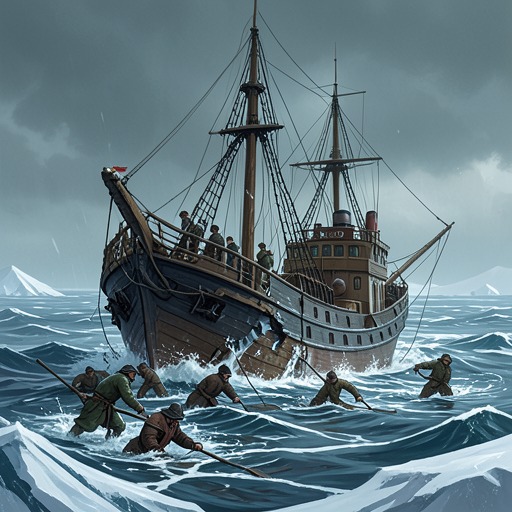
Once inside Lancaster Sound, the crew’s work is shaped by the ice’s movement. A sudden shift of wind from south to north drives loose pack ice toward the Volunteer. Cavendish moors the ship beside a southerly land floe and orders the men to cut an ice dock for protection. The response turns the floe into a worksite: men carry up saws, ropes, poles, and gunpowder, mark the intended cuts, and use teams to operate long steel saws through ice six feet thick. The dock’s sides extend two hundred feet, and the labor divides a section of floe into large pieces.
This construction offers temporary protection but also shows how little control the crew has over the surrounding field. As the pack advances, gaps between separate floes close, turning a loose collection of ice into a continuous mass moving toward the ship. The ice dock is therefore a practical answer to an immediate threat, not a way to remove the danger. Lancaster Sound’s conditions repeatedly demand strenuous, coordinated labor while leaving the ship vulnerable to forces the crew cannot command.
The Planned Loss and Narrative Significance
The ice-bound setting also serves the plan to sink the Volunteer. Cavendish considers the possibility of sinking the ship later if it does not go down in the present conditions, but recognizes that a later loss would be less convincing than one associated with the ice dock already built. Campbell likewise cautions that the timing and appearance of the sinking matter: an obvious act could draw questions from the underwriters. The Sound’s hazards thus have a double use in the plot. They threaten the crew, and they offer a plausible account for the ship’s destruction.
The scheme’s concealment depends on turning a commercial decision into an apparently ordinary maritime disaster. The proposed insurance proceeds, the need to avoid scrutiny, and the effort to make the loss look credible connect the remote passage to the financial interests of Baxter, Brownlee, Cavendish, and Campbell. Later, Sumner accuses Baxter of having Cavendish sink the Volunteer and describes the intended sequence in which Drax and Sumner would also have been killed; Baxter disputes Sumner’s account and points instead to the deaths at the timber yard. The Sound is consequently associated not only with physical peril but with the unresolved truth of the ship’s loss: its dangerous ice makes the intended deception plausible, even as the surviving characters’ conflicting accounts expose the human design behind it.